Home
About Us
Company Profile
Qualification Certificate
MESSAGE
Product
reflow temperature real-time monitoring system
Temperature Profiling
Solder paste thickness gauge
General accessories
Infrared temperature sensors
News
SMT Technical Literature
Industry Information
Corporate News
Contact Us
CH | EN
All Categories>
Further Discussion on the Setting of Temperature Curve for Lead-free Reflow Soldering
2023-09-06
Due to the need to use some lead-free components on the original tin-lead circuit board, the problem of backward compatibility arose.
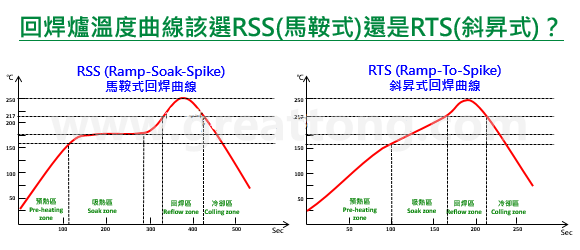
PCBA Lecture Hall: Should RSS be used for the furnace temperature curve of reflow soldering? Or RTS type?
2022-10-16
Should the reflow temperature profile be set to RSS (saddle style)? Is it better to set it to RTS type (inclined lift)? TESDATA has found that many PCBA engineers have been troubled by this issue because a boss has requested RTS, but they are also psychologically afraid.
Discussion on Technical Requirements for Perforated Reflow Welding
2021-09-08
Perforated reflow soldering is an emerging technology in international electronic assembly applications. When there are both mounting components and a small number of sockets and other plug-in components on the same side of the PCB, we usually adopt the method of first mounting through the reflow furnace, and then manually inserting through wave soldering. However, if perforation reflow soldering technology is adopted, it is only necessary to insert the plug-in components and pass them through the reflow furnace together after the patch is completed and before entering the reflow furnace.
CSP and Flip Chip Assembly Using Adhesive Flux (III)
2020-03-06
Table 1 contains the calculated safety boundaries and mounting accuracy for the flip chip used in the experiment, as well as three different solder mask thicknesses. Table 1. Calculated safety boundary and mounting accuracy: Tin ball diameter 190 microns, solder mask layer opening 190 microns, solder mask layer opening 160 microns, solder mask layer thickness (micrometers), safety boundary (micrometers), mounting accuracy (micrometers), mounting accuracy (micrometers) 5306501042533815514429. For flip chip and solder mask layers with reference points defined by local solder mask layers, the conclusion is:. In terms of solder ball diameter, minimum solder mask opening, and solder mask layer
CSP and flip chip assembly using adhesive flux (II)
After installation, weld the board and conduct electrical testing on the components. The measurement results of the daisy chain are shown in Figure 2 with blue dotted lines. The theoretical tolerance position for resistance welding is also shown in the figure. The three theoretical areas are: a consistently good and safe area, corresponding to the copper foil solder pad or welding area. a transition area, which is the tolerance area for solder resistance; But when mounted here, the welding will depend on the position of the solder mask An area that always goes wrong, which exceeds the tolerance limit of resistance welding; The connection in this area is not welded. The measurement of several boards shows that the position (tolerance) of the resistance welding is not always consistent, which may
CSP and flip chip assembly using adhesive flux (1)
2020-03-05
In this article, a recent research project has discovered how component spacing and board layout affect placement accuracy for CSP and flip chip.